For many schools, MTSS has become synonymous with intervention. While intervention is an important component of a responsive system, MTSS was never intended to function solely as a process for identifying students who need additional support.
At MTSS By Design, we believe MTSS works best when it is understood as a coherent system that responds to the needs of all learners. The question is not: "Which students belong in which tier?" The question is: "How does the system respond to learner needs?" This distinction changes everything.
Every learner deserves access to high-quality core instruction and meaningful learning experiences. We believe Tier 1 serves as the foundation of a strong MTSS framework, creating the conditions that allow support, intervention, extension, and enrichment to operate within one coherent system.
Students should never be defined by a tier designation. We believe tiers describe the level of response provided by the system, not the identity of a learner. As needs, strengths, readiness, and circumstances change, learners should move fluidly across available pathways.
Data should help educators determine the next best response for learners. We believe evidence is most valuable when it informs instructional decisions, guides learner movement, and strengthens systems, rather than being used primarily to sort, label, or categorize students.
Effective systems are never finished. We believe MTSS should function as a continuous improvement framework that helps educators regularly examine evidence, evaluate impact, identify barriers, and refine practices. Sustainable improvement occurs when schools consistently learn from their results and adjust in response to the needs of learners.
MTSS should be intentionally designed to serve every learner. We believe effective systems provide pathways for intervention, support, extension, and enrichment, ensuring that all students have access to the opportunities, challenges, and resources they need to grow.
Sustainable improvement occurs when systems work together toward a shared purpose. We believe schools achieve better outcomes when instruction, assessment, learner support, enrichment, collaborative teams, and leadership practices are aligned within a coherent and responsive framework.
If schools intentionally design coherent systems anchored in strong Tier 1 instruction, use evidence to guide decision-making, create responsive pathways for support and challenge, and continuously improve how the system functions, then all learners will experience greater access, engagement, growth, and opportunity.

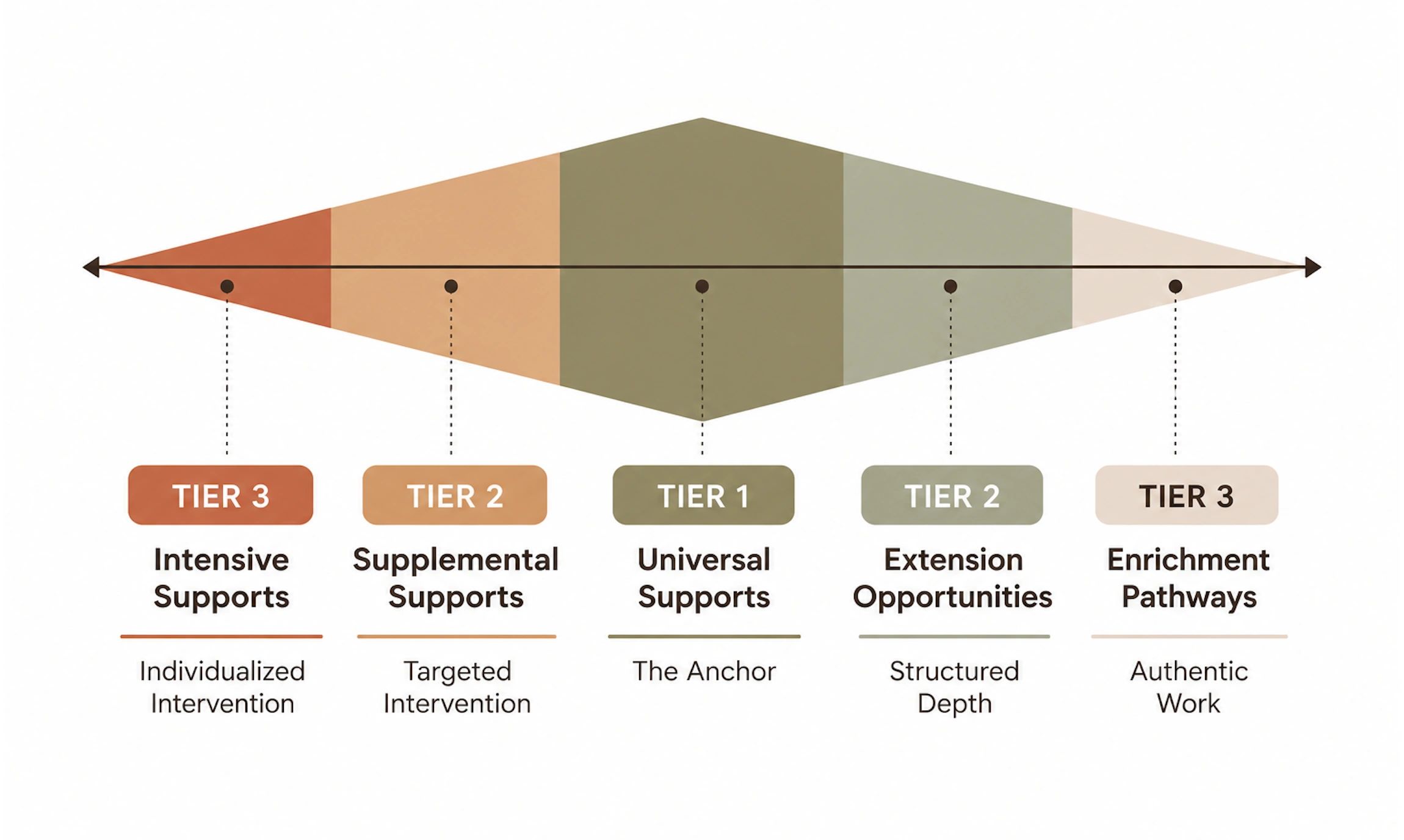
The MTSS Diamond positions Tier 1 as the anchor of the system and illustrates how learners move across multiple pathways based on their needs.
Unlike traditional models that can unintentionally emphasize intervention alone, the Diamond highlights the importance of designing equally intentional pathways for supplemental support, intensive intervention, extension opportunities, and enrichment pathways all anchored in Tier 1.
The MTSS Diamond reflects the belief that learners continuously grow, change, and develop. Effective systems respond flexibly as strengths, needs, interests, and readiness evolve over time.
The MTSS Diamond reflects the belief that learners benefit from multiple pathways for growth. Effective systems respond intentionally through support, intervention, extension, and enrichment over time.
The MTSS Diamond reflects the belief that learners should move fluidly across pathways. Effective systems respond to evidence by providing appropriate support, challenge, and opportunity over time.
Building instructional systems that provide all learners with access to high-quality learning experiences through strong core instruction and responsive, intentional planning.
Creating structures for intervention, progress monitoring, attendance, behavior, and learner support that respond to need without creating fragmentation.
Ensuring learners have access to opportunities that deepen learning, cultivate talents, expand interests, and encourage continued growth and improvement.
Developing collaborative structures that help teams use evidence effectively, engage in problem-solving, and make decisions that lead to action.
Supporting leaders in creating conditions for implementation, alignment, continuous improvement, and long-term sustainability.
Creating structures that ensure learners actively participate in goal-setting and decision-making while incorporating learner perspectives into improvement efforts.
Too often, improvement efforts are implemented as separate initiatives, competing priorities, or disconnected programs.
The MTSS Diamond provides a framework for bringing those efforts together into a coherent system that responds to learners while strengthening the conditions that support success for everyone.
Because effective MTSS is not about where students fit within a framework.
It is about how the framework responds to students.
We use cookies to analyze website traffic and optimize your website experience. By accepting our use of cookies, your data will be aggregated with all other user data.